|
The Technological Options provide Corte with a great flexibility to configure a wide range of different cutting types, in many different practical environments. However, there could exist some special cutting types for which such a configuration is neither evident nor straightforward as it would require both a suitable selection of the technological options involved and the imposition of certain rules in data definition. As a way of exemplifying this, we show next two of such special cutting types:
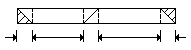
- For each profile to cut, introduce a part of Length equal to the straight (rectangular) area of the profile, without including any of its two extremes beveled at angle. - Define the Cut Width as the length of the cut at angle, measured horizontally along the profile. - Define Left and Right Margins with the same value as the Cut Width in order to the first and last profiles can be correctly cut.
Parts Layout Optimization for CNC Punch Presses: CNC Punch Press programs define punching patterns allowing to manufacture parts by using a set of standard-shaped punches. Such programs generally support code for multiple part punching, that is, simple instructions that repeat incrementally the punching pattern for a single part in order to extract, with no extra effort, multiple instances from the same plate.
When breaking down a complex equipment or product into their component parts, often occurs that several part types need to be all manufactured from the same material and each part type at a certain quantity. Here a cutting optimization problem arises: to find optimum part layouts on the available material so that the CNC press manufacture restrictions are all fulfilled and the material consumption is minimized. Such a problem can be configured in Corte as follows: - Define different launches for different materials according to material thickness and composition. - For each punched part type, find the rectangle circumscribing its punching pattern (external contour punches generally suffices it) to define the corresponding part in Corte. - Define the Cut Width as the distance that should be left between external contour punches in order to guarantee material strength. - Define the necessary Margins, specially the Inferior one that would guarantee a safety zone for holding the material. - Define the Cut Maximum Length as the auto-repositioning distance of the press in order to all the parts within a final semiproduct can be extracted without repositioning. - If CNC code for 90-degress-rotated parts can be easily obtained, activate Rotate Parts to increase chances for optimizing. On the contrary, do not activate this option. - Enter the available materials with their original dimensions.
All the CNC parameters needed for multiple part punching (coordinates origin and part layout of each final semiproduct) can be obtained from the Cutting Parameters report and also the Patterns Sheet. |


|
Corte 4 Copyright © 2003-2006 CorteOptimo.com All rights reserved |
|
4.3 |

|
Configuring the Launch |
|
4 |