
|
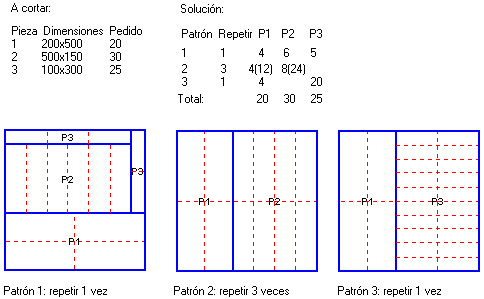
A solution for the cutting task is a set of cutting patterns, in which each pattern has a certain multiplicity or repetition value indicating how many material units in the stock should be cut off according to that pattern. Since a single part could be distributed among different patterns, the whole request will be fulfilled when all the patterns have been realized, each of them as many times as indicated by its repetition. In general, the number of pattern types in the solution is expected to be closely above the number of part types. The solution will be optimum if the generated offcut is the minimum reachable according to the dimensions of the parts and materials. |


|
Corte 4 Copyright © 2003-2006 CorteOptimo.com All rights reserved |
|
2.2 |

|
Basic concepts |
|
2 |


|
A characteristic inherent in the Corte‘s mathematical model is the calculation of the optimal solution by assigning their patterns with fractional (not integer) repetitions. We call such a solution the theoretic solution, since it can’t be directly realized in practice.
Note: For example: The phrase “repeat a pattern 3.56 times” has no practical sense because what “cutting a pattern 0.56 times” means is not defined. It could be thought as “extract each part distributed in the pattern as many times as 0.56 of its original quantity”. However, such an argument say nothing about the cutting topology, that is, how to cut the new quantities and what to do with the generated offcut.
Nevertheless, as program usage has demonstrated, the theoretic solution does constitute a good starting point in order to obtain an integer solution realizable in practice and having a high probability of being optimal too. In Corte, such integer solution is obtained via a suitable rounding of the theoretical multiplicity.
Corte implements rounding in three ways:
· Up: The whole parts request (order list) is fulfilled upwards by minimizing the standard deviation of the actual quantities obtained. · Down: With the same above criteria the whole request is fulfilled downwards. · Exact: The rounded-down integer solution is complemented with additional cutting variants (patterns) until satisfying exactly each part request. We call these variants the completing variants. They can be easily identified as the ones having zero theoretic repetition since they are all calculated outside the mathematical model.
In fact, there will be three integer solutions, one for each rounding. A pattern is considered out of the corresponding integer solution whether its multiplicity gets a null (zero) value after rounding it. To the mathematical model point of view, the only feasible integer solution is the one corresponding to the exact rounding. It can make sure of this solution is optimal if, for each material, the theoretic total repetition rounds up to the integer total repetition. The other integer solutions are optimal only for the part quantities that they actually get which are not, in general, the requested ones. Note: In the rest of this manual, unless stated explicitly, as solution of the cutting task should be understood the rounded-exact integer solution. |