
|
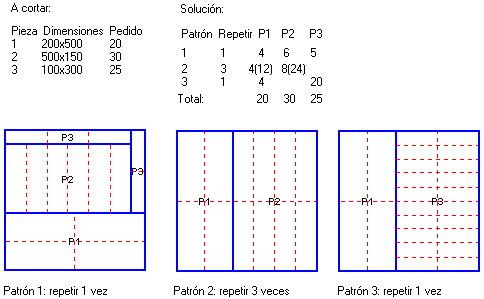
A solution for the cutting task is a set of cutting patterns, in which each pattern has a certain multiplicity or repetition level that indicates how many units of stock material should be cut according to that pattern. Since each part type is to be distributed among several different patterns, the whole parts request is to be guaranteed just when all the patterns are realized, each as many times as indicated by its repetition. In general, the number of patterns in the solution set will be greater than or equal to the number of part types. The solution will be optimum if the generated offcut is the minimum reachable according to the dimensions of the parts and materials. |


|
Corte 3 Professional Edition Copyright © 2003-2005 Neginter del Caribe Ltd. All rights reserved |
|
2.4 |

|
Basic Concepts |
|
2 |
|
Theoretical and Integer Solutions |
|
A characteristic inherent in the mathematical model inside Corte is the calculation of the optimal solution by assigning fractional multiplicities to the generated patterns. Such a solution is called the theoretical solution because it can not be directly realized in practice. Note: For example: The statement “repeat a pattern 3.56 times” has no practical meaning because what “cutting a pattern 0.56 times” means is not defined. The argument, for example, of getting each part as many times as 0.56 of its multiplicity in such a pattern say nothing about the cutting topology, that is, how to cut the new quantities and what to do with the generated offcut. Nevertheless, as the program use has proved, the theoretical solution certainly constitutes a good starting point to reach an integer solution that can be realized in practice and also has a high probability of being optimal. In Corte, such integer solution is obtained by a suitable rounding of the above mentioned theoretical multiplicities.
Corte implements rounding in three ways:
Up (from the exact parts request) The whole parts request is equaled or over-satisfied by minimizing the standard deviation of the actual quantities obtained.
Down (from the exact parts request) The same as above but now equaling or under-satisfying the parts request.
Exact The rounded down integer solution is complemented with additional cut variants until fulfilling exactly the whole parts request. These variants are called the completing variants and will always have zero theoretical repetition since they are all calculated outside the mathematical model.
Note: There will be actually three integer solutions, one for each rounding. A pattern is considered out of the corresponding integer solution whether its multiplicity rounds to zero. From the mathematical model’s point of view, the only feasible integer solution is the rounded-exact one. It can make sure of this solution is optimum if, for each material, the total theoretical repetition rounds up to the total integer repetition. The other integer solutions are optimum only for the parts quantities that they actually obtain, which are not, in general, the requested ones. (see the Results Sheet) |